Toward a future that preserves benefits of neurotechnology for all | MIT News
As advanced medical technology gets closer to hitting consumer markets, the need for guardrails on protected usage should increase. What might begin as a neural implant to aid in communication could become a device used to police one’s innermost thoughts.
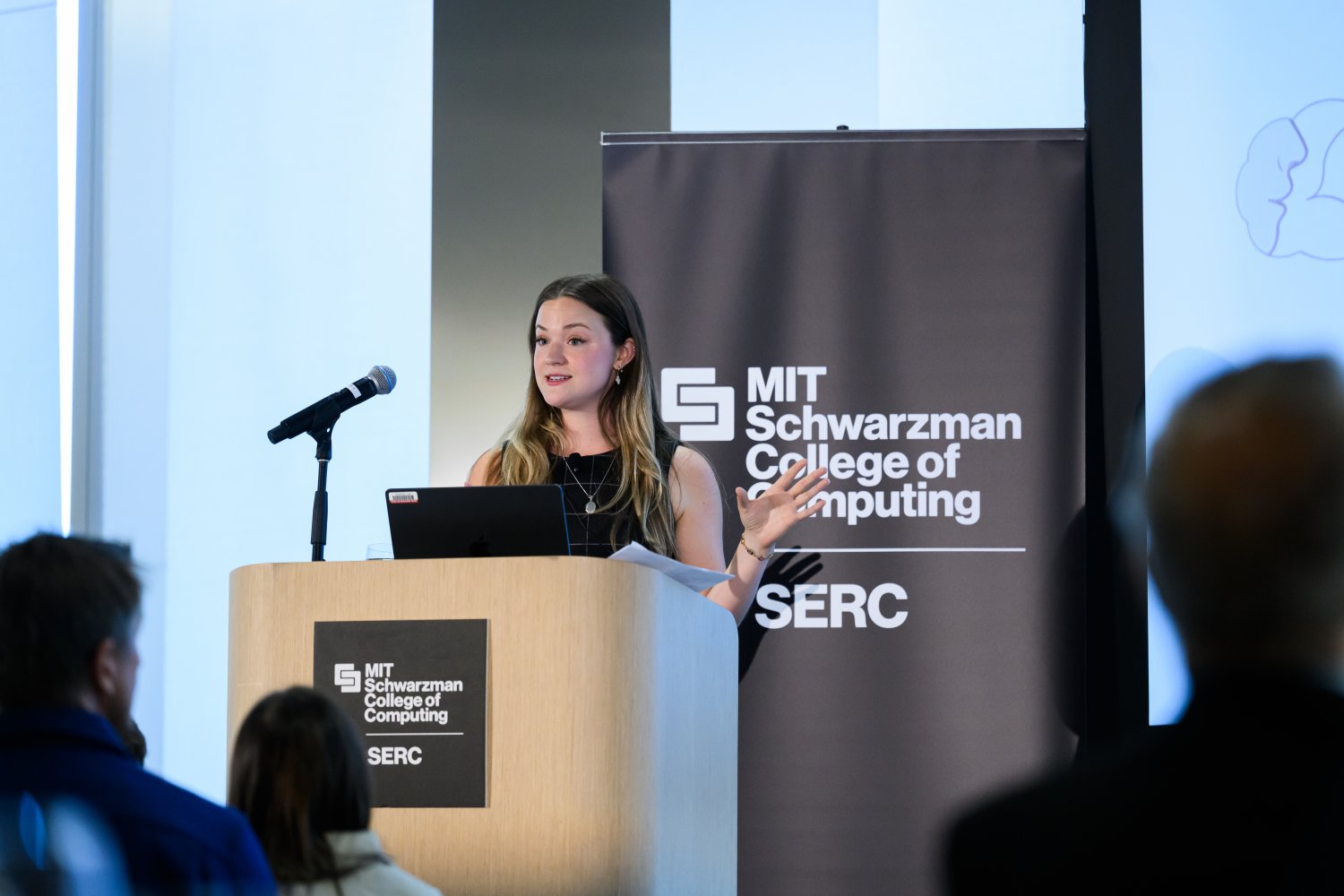
Intrigued by the far-reaching benefits and risks of neural implants, Rachel Sava, a PhD candidate in the Harvard-MIT Program in Health Sciences and Technology, explores how a life-changing medical device can become a tool for surveillance by corporations and government entities in her winning submission, “Superintelligence, Superintimate,” for the fourth annual Envisioning the Future of Computing Prize.
Sava’s concept was inspired by an internship at IBM, where she worked on a project with the PACE Center in London. “A mentor on the project was Kevin Brown, who had himself designed one of the earliest brain decoders — an EEG-based system he built for a colleague who had suffered a stroke that left him with locked-in syndrome,” she says. “It was this patient population for whom the body has become an unreliable vehicle for the mind that motivated my writing about neuroprostheses some six years later.”
Sava explains that research and applications right now are at a “watershed moment in neurotechnology.” Using examples like companies taking advantage of neural implants to monitor mental productivity, or authorities policing a population for “thought crimes,” Sava said that as this tech hits consumer markets, there is a genuine fear that what starts as a revolutionary medical device could transition into more dystopian usages.

Envisioning the Future of Computing Prize 2026: Rachel Sava
Video: MIT Schwarzman College of Computing
Presented by the Social and Ethical Responsibilities of Computing (SERC), a cross-campus initiative of the MIT Schwarzman College of Computing, in collaboration with the School of Humanities, Arts, and Social Sciences and with support from MAC3 Philanthropies, the competition invited MIT students to identify, in 3,000 words or fewer, which sector stands to gain the highest net positive impact from artificial intelligence. Students were encouraged to explore realistic technological deployments while considering potential risks and ethical concerns. All submissions were eligible for cash awards with the grand prize set at $10,000.
During a live awards ceremony hosted by Caspar Hare, former associate dean of SERC and professor of philosophy, who founded the prize in 2023, three finalists each gave a 20-minute presentation on their concepts and took questions from a panel of judges and audience members.
“SERC and the donors who make this prize possible year after year are asking us, the next generation of scientists: ‘what world do you want to see?’ I think it’s worth taking the time to ask yourself the same,” Sava said. “And if, as it did for me, the sentiment grows bright enough to motivate further action — then it’s worth giving yourself permission to explore it as deeply as you do your other academic work.”
Each year, the Envisioning the Future of Computing Prize asks students to look beyond technological advancement and consider the societal benefits and costs of their work from the outset. From its inception, the competition has consistently attracted undergraduate and graduate students from across a wide range of disciplines.
“This year’s submissions were amazing and included essays on brain-computer interfaces, AI and religion, AI for scientific discovery, finding efficiencies in the power grid, and many more,” says Brian Hedden, co-associate dean of SERC and a professor of philosophy, who holds an MIT Schwarzman College of Computing shared position with the Department of Electrical Engineering and Computer Science. “They showed the breadth and depth of thinking going on at MIT on the social and ethics impacts of technologies.”
Nikos Trichakis, co-associate dean of SERC and the J.C. Penney Professor of Management, adds “what is most striking about these essays is the breadth of imagination they display: the students move fluidly across medicine, neurotechnology, law, ethics, and public institutions, while keeping human agency at the center. Their work is creative, rigorous, and deeply thoughtful, showing a remarkable ability to envision not only what AI can do, but what it should do.”
In addition to awarding Sava the $10,000 grand prize, the judges recognized two runners-up with $5,000 each: Cordiana Cozier, a PhD candidate in the Department of Chemistry, for her paper on the use of AI as a cognitive buffer for public defenders; and Strahinja Janjusevic, a graduate student in the Technology and Policy Program in the Institute for Data, Systems, and Society, for his submission on agency and ownership in the field of neural-controlled prosthetics. The judges also named four honorable mentions, each of whom received a $500 cash prize.