MIT affiliates win 2026 Hertz Foundation Fellowships | MIT News

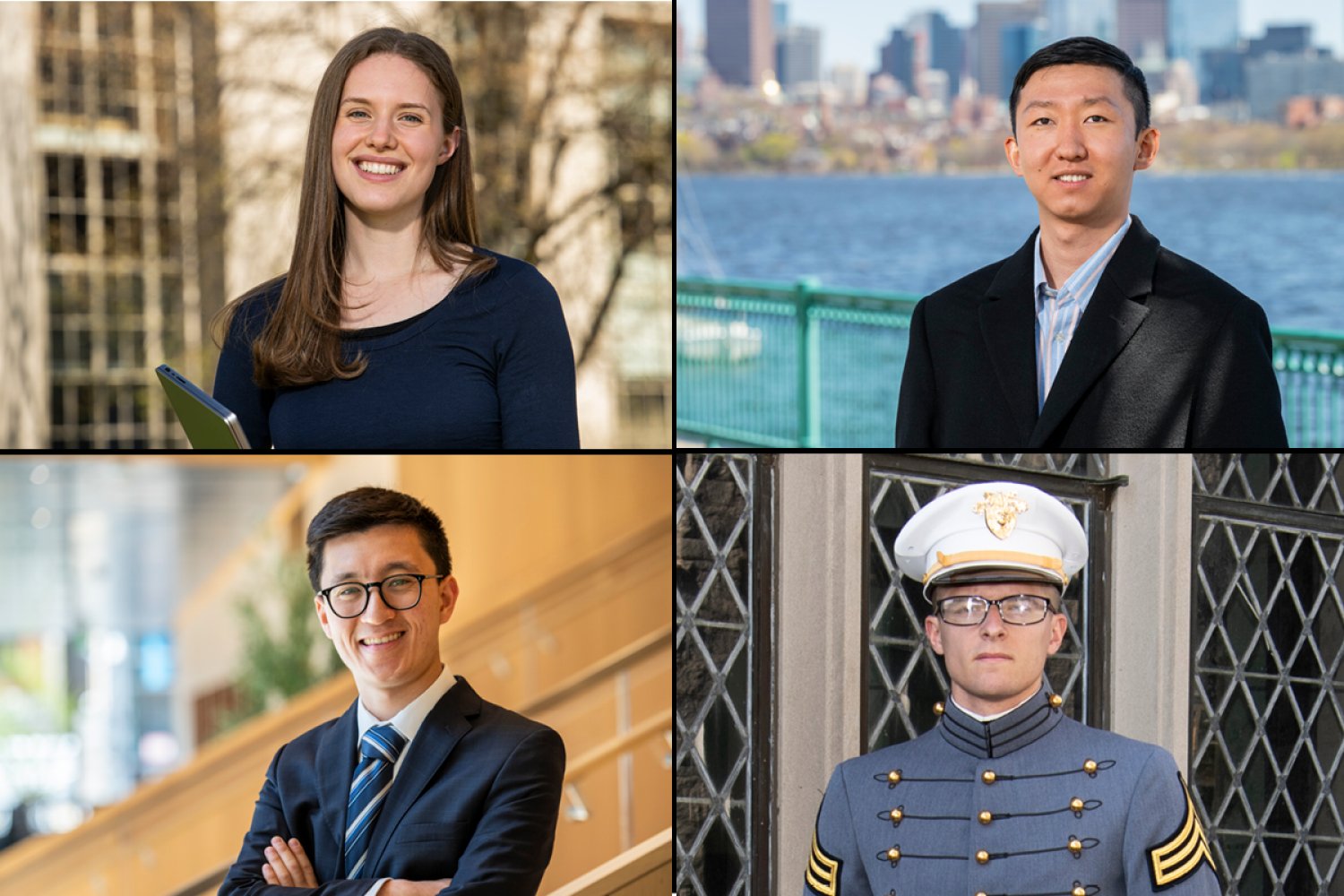
The Hertz Foundation announced that it awarded 2026 fellowships to three current MIT students as well as an incoming graduate student. They are: Annika Marschner, Alvin Q. Meng, Zachary S. Siegel, and Matthew Wanta.
The prestigious science and technology award provides each recipient with five years of financial support — a stipend and full tuition equivalent — which gives them an unusual measure of autonomy to pursue ground-breaking research in their graduate work.
“What particularly impresses me about this cohort is their fearlessness in taking on new challenges and advancing the frontiers of science,” says Philip Welkhoff, a Hertz Fellow and director of the malaria program at the Gates Foundation, who co-led the selection process. “Each has exhibited tremendous creativity, grit, and vision, and I cannot wait to see what each accomplishes with the freedom to innovate provided by the Hertz Fellowship.”
In addition to funding, fellows receive lifelong access to Hertz Foundation programs including events, mentoring, and networking opportunities, with the over 1,300 fellows named since the fellowship was established in 1963. The connections forged among these individuals have sparked collaborative startups, research, and commercialization in a range of technology, science, and engineering fields. Hertz Fellows have contributed to breakthroughs in such areas as advanced medical therapies, global defense networks, and the James Webb Space Telescope.
This year’s MIT-affiliated recipients are among a total of 19 Hertz Foundation Fellows scholars selected from across the United States.
Annika Marschner ’26 majored in mechanical engineering and will begin her PhD at MIT in the fall. Her undergraduate research centered on the development of novel technologies for both biointerfacing and bio-inspired systems, including a custom benchtop stereoscope-compatible incubator and extrusion-based desktop bioprinter for MIT’s Raman Lab, a light-based filamented bioprinting system for ETH Zürich’s Tissue Engineering and Biofabrication Lab, and large-scale hardware designs for robotic systems in MIT’s Biomimetic Robotics Lab. Marschner’s undergraduate thesis focused on improving the speed and dexterity of dynamic motions in bio-inspired robotic limbs. As a graduate student, she plans to continue her work on both hardware and control system design in biologically relevant settings, especially in the areas of assistive medical technology and surgical robotics.
Alvin Q. Meng is doctoral student in inorganic chemistry focusing on understanding the fundamental interactions underlying chemical structure and reactivity. He is currently studying iron-sulfur clusters under the guidance of Professor Daniel L.M. Suess. Born in Tianjin, China, Meng immigrated to the United States at the age of 10. He received undergraduate degrees in chemistry and mathematics from the University of Virginia, where he worked in the research group of Professor W. Dean Harman. His research involved the synthesis and characterization of dihapto-coordinated tungsten complexes of cyclopentadiene, focusing on a class of unusual binuclear species containing a carbon–carbon bond linking two metal-bound five-membered rings.
Zachary S. Siegel is an electrical engineering and computer science graduate student pursuing a PhD in the Computer Science and Artificial Intelligence Laboratory, where he works at the intersection of robotics, cognitive science, and artificial intelligence. He graduated summa cum laude from Princeton University with a BSE in computer science and a minor in philosophy, receiving honors including Tau Beta Pi, Sigma Xi and the Outstanding Computer Science Independent Work Prize. His senior thesis, advised by Tom Griffiths and Jacob Andreas, investigated how humans infer the goals of others in open-ended, real-world environments. Siegel demonstrated how Bayesian inference serves as an accurate model of people’s goal predictions by comparing partial observations to a learned library of possible plans weighted by their prior likelihood. His doctoral research goal is to build machines that learn and reason more like people — systems that can learn from limited data and generalize to new situations by combining robot planning and Bayesian inference. Siegel is particularly interested in combinatorial generalization: the human capacity to compose known skills in novel ways to solve previously unseen problems without additional demonstrations. At MIT, he is advised by Leslie P. Kaelbling, Tomás Lozano-Pérez, and Joshua B. Tenenbaum.
Matthew Wanta is an incoming doctoral student who will begin operations research at MIT in the fall. He is a class of 2026 graduate of the United States Military Academy at West Point with a bachelor’s degree in computer science and mathematical sciences, both with honors. His work centered on machine learning for autonomous systems, integrating probabilistic modeling and computer vision into cooperative drone search and swarm control frameworks. In collaboration with DEVCOM Armaments Center, Wanta developed computer vision models for detecting energetic defects in artillery munitions, enabling rapid, nonintrusive quality control in defense manufacturing. His work with U.S. Special Operations Command and Army C5ISR organizations focused on autonomous aerial search and sensing, where he built simulation architectures for probabilistic target localization and multi-agent coordination. Wanta served as company commander for Bravo Company, 2nd Regiment; president of Upsilon Pi Epsilon; and vice president of Phi Kappa Phi. He is an Astronaut Scholar and Sapper School graduate, and commissioned as an Army officer in the Cyber Corps.